

So you’ve started reading about what happens to your body when you’re pregnant.
Perhaps you’re already pregnant, and you’ve been to an appointment or two and people keep talking to you about your cervix.
You may wonder what it looks like or feels like and want to try and find it yourself.
What is the Cervix?
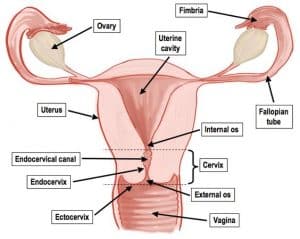
The cervix is the ‘neck’ of your uterus; it’s a narrow passage located right at the bottom of the uterus, connecting with the top of the wall of the vagina.
When you give birth vaginally, your cervix thins and opens to allow your baby to move down and out.
This process of thinning and opening is often called ‘effacing and dilating’.
Don’t worry if you don’t know much about your cervix. Most of us don’t have much reason to think about it until we’re pregnant!
But it’s useful to arm yourself with a little knowledge so that you can understand the changes that take place — and so you know what your obstetrician or midwife is talking about.
What does my cervix look and feel like normally?
When you’re not pregnant, your cervix is usually pink, about 4-5 cm long, with walls about 1 cm thick and a very, very narrow passageway in the middle.
The top end of the cervix connects with the bottom of the uterus, and bottom end of the cervix protrudes about 1 inch into the vagina.
It looks a bit like a rubber ring or donut.
The way it feels when you’re not pregnant can change depending on where you are in your menstrual cycle.
Sometimes it feels low, firm, tightly closed and relatively dry; and at other times (particularly during ovulation, when you’re most fertile) it might feel higher up in your vagina, softer, more wet, and a little more open.
What does the cervix feel like when you’re pregnant?
During pregnancy, your levels of a hormone called estrogen rise quickly, and your body directs more blood to your cervix and pelvis to support your growing baby and prepare for birth.
This makes the surface softer and it might feel a bit like velvet if you touch it. It gets a little wider and rises higher up in the vagina.
That very narrow passageway in the cervix is often called the cervical canal. In very early pregnancy, glands in the cervix release a thick mucus which becomes a ‘plug’ for the cervical canal, preventing any bacteria getting up into the uterus.
This stops your growing fetus from picking up any infections.
That mucus plug stays there right until the end of your pregnancy.
In fact, many women say that the first sign they had that they were going into labor was when their plug came out into their underwear or on toilet paper; this is often called a ‘show’ or ‘bloody show’.
Not everyone notices it, though — it sometimes happens slowly over a period of a couple of weeks, rather than all at once.
Can I find my cervix and feel it on my own?
Yes, you can. Before I tell you how to do this, there are two important things to note:
1. Hygiene!
You don’t want to get any dirt or bacteria up in your vagina when you’re pregnant (or at any time, really). So before you start, wash your hands thoroughly with antibacterial soap and dry them completely.
Also, resist the temptation to do this too often — especially once you know you’re pregnant.
There’s no need, and it could do more harm than good.
2. Feeling your cervix cannot tell you whether you’re pregnant or not.
Although your cervix will go through changes in pregnancy, these changes happen at different times for different women — and how your cervix feels when you’re pregnant might not be the same as the next woman’s.
So if you want to feel your cervix to figure out whether you’re pregnant or not, stop.
Go to the pharmacy and pick up a home pregnancy test (or ten…we know how it is), and wait until the day your period is due before you test.
That said, if you’re interested in getting to know your cervix, here’s how:
- Get comfortable — sitting on the edge of a chair, bed or bathtub works for most women.
- With clean hands, insert your longest finger into your vagina. Your cervix will be between 3-6 inches inside, so take your time and feel around. It helps to use a lubricant — but read the label to make sure it’s safe during pregnancy before you do so.
- You’ll know you’ve found your cervix when your fingertip touches an opening at the end of your vagina, shaped like a donut. If you’re pregnant, then it’s likely (but not definite!) that your cervix will feel closed, soft, and be quite high up in your vagina.
What about cervical positions?
As well as being higher or lower in the vagina, the position of your cervix can change from being further back to further forward during pregnancy.
There’s no need to think about the position of your cervix in early pregnancy, but it does become more important as you move closer to birth.
For your baby to move into the cervical canal and out of your vagina, the cervix needs to be forwards — if it’s too far back, the baby’s head may be behind the cervix and then it won’t be able to move down.
That’s why your doctor or midwife might check the position of your cervix when you’re in the final weeks of pregnancy.
But there’s nothing you can do to change the position of your cervix. And it can move into the right position at any time — just because it’s too far back when you’re 38 weeks pregnant does not mean that your body won’t shift things around as you prepare to give birth.
And if your cervix is still far back when you’re in labor your obgyn or midwife may pull it forwards.
This is a bit uncomfortable (I’ve had it done twice) but it’s over quickly and any discomfort passes quickly, so there’s no need to be worried about it.
What happens to the cervix just before birth?
As the time to push (or breathe) your baby out gets closer, your cervix will begin to thin (efface) and soften. You might feel some twinges in your cervix at this time. It can range from a barely noticeable tugging feeling, to a sharp pain.
One woman’s cervix might start to efface weeks before birth, and another woman’s cervix might start to efface only hours before birth.
Everyone’s different.
As well as feeling softer, the cervix sometimes changes color in the late stages of pregnancy, becoming blue or pale purple as your body sends even more blood to circulate in the area.
You probably won’t see this yourself, but if your doctor or midwife looks at your cervix with a speculum, they’ll be able to see the color.
What Does it Feel Like When My Cervix is Dilating During Labor?
Strangely enough for most women there’s little if any sensation when your cervix dilates during in labor. You’ll certainly feel your contractions, usually in your lower back and/or your stomach, but the dilating not so much.
You’ll feel pressure in that region and a baring down sensation but that is more to do with baby’s head moving down rather than the actual process of dilation.
Key Points to Remember:
- Every woman’s body is different, and every cervix is different. Don’t worry too much about what yours feels like.
- Feeling your cervix cannot confirm whether or not you’re pregnant.
- You can check your cervix yourself during pregnancy, but there’s no need to do this unless you’re really interested in feeling it. It’s not a requirement.
If you have any questions or worries about your cervix, always talk to your doctor or midwife. We know it can feel strange to ask questions about the inside of your vagina — but your doctor’s job is to look after you and help you make informed choices the whole way through your pregnancy and labor.
They’ll be experts in how cervixes look and feel at different stages of pregnancy, so be reassured that any questions you have about yours will not come as a surprise.
Sources:
- https://www.womenshealthmag.com/health/a19977125/cervix-pictures/
- https://www.sciencedirect.com/science/article/pii/S2214854X1530008X
- https://www.bellybelly.com.au/pregnancy/how-does-your-cervix-feel-when-pregnant/
- http://www.bounty.com/pregnancy-and-birth/pregnancy/early-pregnancy/changes-in-your-cervix-during-early-pregnancy
- https://www.healthline.com/health/pregnancy/cervix-in-early-pregnancy
- https://www.ourbodiesourselves.org/book-excerpts/health-article/the-cervix-close-up/